Material comparison

Nylon (PA6 / PA12) vs PA-CF: which one?

A tough, wear-resistant engineering plastic with low friction. An industrial filament combining nylon's toughness with carbon fiber's stiffness. So which one is right for your project? Compare the values, strengths and weaknesses side by side.

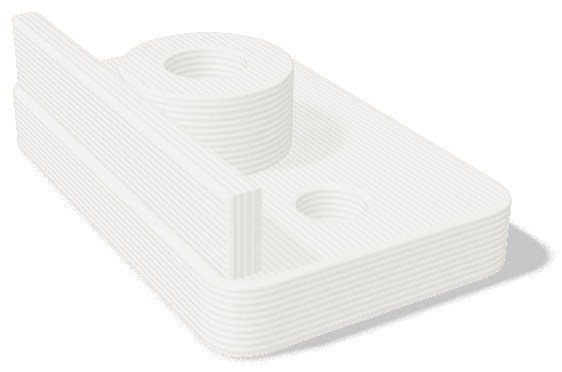
Sample part made from Nylon (PA6 / PA12)

Nylon (PA6 / PA12)

Polyamide filament

Nylon (polyamide) is the classic material for parts that see friction and impact, such as gears, bushings and hinges. It stands out for its toughness, wear resistance and low friction coefficient. Because it absorbs moisture, humidity must be controlled before printing and in use; as it absorbs moisture it becomes more flexible and tougher.

Strength3
Stiffness2
Toughness / impact5
Heat resistance3
Chemical resistance4
UV / outdoor2
Detail and surface3
Ease of production2
Nylon (PA6 / PA12) page →
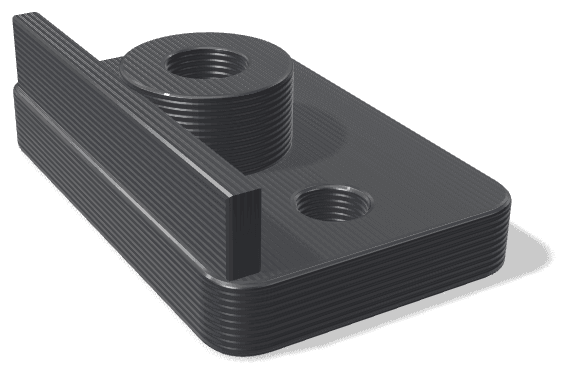
Sample part made from PA-CF

PA-CF

Carbon fiber reinforced nylon (PA6-CF / PA12-CF)

PA-CF is polyamide reinforced with chopped carbon fiber. It is much stiffer and more dimensionally stable than unreinforced nylon, and its heat resistance increases significantly. It is often used for fixtures, jigs, robot grippers and lightweight structural parts that replace metal.

Strength4
Stiffness5
Toughness / impact3
Heat resistance4
Chemical resistance4
UV / outdoor3
Detail and surface3
Ease of production2
PA-CF page →

Values

Technical comparison

PropertyNylon (PA6 / PA12)PA-CF
Density1.1 g/cm³1.2 g/cm³
Tensile strength55 MPa85 MPa
Elongation at break50 %3 %
Modulus (stiffness)1.6 GPa6 GPa
Heat deflection (0.45 MPa)80 °C160 °C
  • PA-CF has higher tensile strength: 85 MPa, versus 55 MPa for Nylon (PA6 / PA12).
  • PA-CF is more heat resistant: 160 °C, versus 80 °C for Nylon (PA6 / PA12).
  • Nylon (PA6 / PA12) stretches further before breaking: 50 %, versus 3 % for PA-CF.
  • PA-CF is stiffer: 6 GPa, versus 1.6 GPa for Nylon (PA6 / PA12).

Decision

Which one, and when?

Choose Nylon (PA6 / PA12) if…

  • Toughness / impact matters more
  • you are making gears and bushings
  • you are making hinges and clips
  • you are making wear plates

Choose PA-CF if…

  • Stiffness matters more
  • Strength matters more
  • Heat resistance matters more
  • UV / outdoor matters more
  • you are making fixtures and assembly tooling
  • you are making robot gripper fingers
  • you are making drone and automotive structural parts

Good to know

Nylon (PA6 / PA12) vs PA-CF: frequently asked questions

Which is stronger: Nylon (PA6 / PA12) or PA-CF?

PA-CF has higher tensile strength: 85 MPa, versus 55 MPa for Nylon (PA6 / PA12).

Which is more heat resistant: Nylon (PA6 / PA12) or PA-CF?

PA-CF is more heat resistant: 160 °C, versus 80 °C for Nylon (PA6 / PA12).

Which is easier to produce?

Both materials are similarly easy to produce.

Which is more economical?

Price levels are similar; the exact price depends on the part and quantity.

Which one is right for your part?

Tell us the operating conditions; let's decide together which of the two fits, or find a better alternative.