FDM · Filaments · High performance
PEKK filament
From the PEEK family; a high-performance polymer used in aerospace and space that prints more easily.
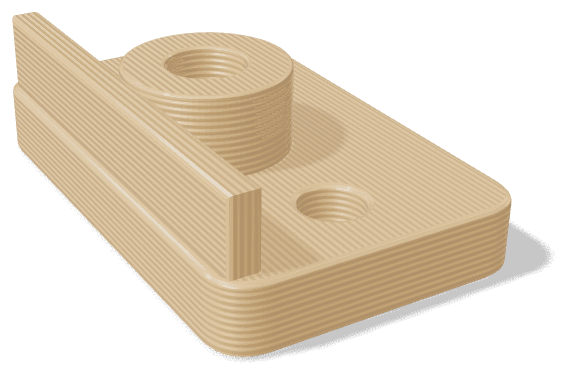
What is PEKK?
PEKK belongs to the PAEK (polyaryletherketone) family. It has chemical and thermal resistance similar to PEEK, but because it crystallizes more slowly it offers better layer adhesion and is easier to print with FDM. It is also preferred in space applications thanks to its low outgassing.
- Heat resistant
- Chemical resistant
- High strength
- Flame retardant
Technical data
Typical values compiled from common manufacturer datasheets; they vary by brand and grade.
| Density | ≈ 1.27 – 1.30 g/cm³ |
|---|---|
| Tensile strength | ≈ 90 – 100 MPa |
| Elongation at break | ≈ 3 – 6% |
| Glass transition temperature (Tg) | ≈ 150 – 160 °C |
Print settings
Recommended starting ranges; fine-tuning is needed for each machine.
| Nozzle temperature | 340 – 380 °C |
|---|---|
| Enclosure | Heated chamber |
| Printer | Industrial FDM |
Design guidelines for PEKK
General guidelines for FDM technology. All design guidelines
- Minimum wall thickness0.8 mm
- Smallest detail0.4 mm (nozzle diameter)
- Clearance for moving parts0.3 – 0.6 mm
- Text and logosEmbossed ≥ 0.6 mm, engraved ≥ 0.8 mm
- Minimum hole diameterØ 2 mm
- Unsupported overhang angle≥ 45° from horizontal; flatter surfaces need support
Applications
- Aerospace and space parts
- Fuel system components
- Parts for chemical environments
Advantages
- PEEK-class strength
- Better layer adhesion
- Low outgassing
Limitations
- Expensive
- Requires an industrial printer
Comparison
PEKK and alternatives
| Property | PEKK | PEEK | ULTEM™ 1010 | PPS-CF |
|---|---|---|---|---|
| Density | 1.28 g/cm³ | 1.29 g/cm³ | 1.27 g/cm³ | 1.35 g/cm³ |
| Tensile strength | 93 MPa | 100 MPa | 81 MPa | 80 MPa |
| Elongation at break | 4 % | 40 % | 3 % | 2 % |
| Modulus (stiffness) | 3.3 GPa | 4.2 GPa | 2.8 GPa | 7 GPa |
| Heat deflection (0.45 MPa) | 150 °C | 150 °C | 216 °C | 240 °C |
Values are averages of typical ranges; see each material page for details.
Good to know
Frequently asked questions about PEKK
What is PEKK?
PEKK belongs to the PAEK (polyaryletherketone) family. It has chemical and thermal resistance similar to PEEK, but because it crystallizes more slowly it offers better layer adhesion and is easier to print with FDM. It is also preferred in space applications thanks to its low outgassing.
Is PEKK heat resistant?
The heat deflection temperature (0.45 MPa) of PEKK is about 150 °C. This is high; it can be used near engine bays, in hot air and steam.
Can PEKK be used outdoors?
Yes. PEKK has good resistance to UV light and weather; it is suitable for outdoor parts.
Which parts are made with PEKK?
PEKK is typically used in applications such as aerospace and space parts, fuel system components, parts for chemical environments.
Which material can be used instead of PEKK?
Depending on the application, PEEK, ULTEM™ 1010, PPS-CF can be alternatives. You can see the differences in the comparison tables on the material pages.
Does TAİ Robotik produce with PEKK?
For PEKK, send us your part's dimensions, quantity and operating conditions; we will determine the best production route and, if needed, an equivalent alternative together.
Let's choose the right material together
Tell us your needs for this material or an alternative we can produce.