FDM · Filaments · Engineering
PP filament
Very light, chemical and fatigue resistant; living hinges are possible.
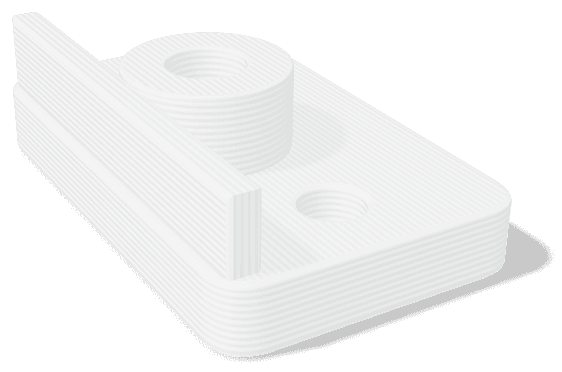
What is PP?
Polypropylene is one of the most widely used plastics in the world. It is light, resistant to acids and bases, and can form living hinges that bend many times without breaking. Printing it with FDM is difficult because of its tendency to warp; the right bed surface and settings are needed.
- Chemical resistant
- Lightweight
- Flexible
- Food-contact grades available
Technical data
Typical values compiled from common manufacturer datasheets; they vary by brand and grade.
| Density | 0.89 – 0.91 g/cm³ |
|---|---|
| Tensile strength | 20 – 30 MPa |
| Elongation at break | 50 – 400% |
| Tensile modulus | 0.6 – 1.2 GPa |
| Heat deflection temperature (0.45 MPa) | 80 – 100 °C |
Print settings
Recommended starting ranges; fine-tuning is needed for each machine.
| Nozzle temperature | 220 – 250 °C |
|---|---|
| Bed temperature | 80 – 100 °C (PP tape surface) |
| Enclosure | Recommended |
Design guidelines for PP
General guidelines for FDM technology. All design guidelines
- Minimum wall thickness0.8 mm
- Smallest detail0.4 mm (nozzle diameter)
- Clearance for moving parts0.3 – 0.6 mm
- Text and logosEmbossed ≥ 0.6 mm, engraved ≥ 0.8 mm
- Minimum hole diameterØ 2 mm
- Unsupported overhang angle≥ 45° from horizontal; flatter surfaces need support
Applications
- Chemical containers and lab parts
- Lids with living hinges
- Automotive parts
Advantages
- Very lightweight
- High resistance to acids and bases
- Living hinges
Limitations
- Strong tendency to warp
- Difficult to glue and paint
Comparison
PP and alternatives
| Property | PP | PP (MJF / SAF) | PETG | Nylon (PA6 / PA12) |
|---|---|---|---|---|
| Density | 0.9 g/cm³ | 0.89 g/cm³ | 1.27 g/cm³ | 1.1 g/cm³ |
| Tensile strength | 25 MPa | 30 MPa | 52 MPa | 55 MPa |
| Elongation at break | 200 % | 20 % | 83 % | 50 % |
| Modulus (stiffness) | 0.9 GPa | 1.6 GPa | 1.07 GPa | 1.6 GPa |
| Heat deflection (0.45 MPa) | 90 °C | 100 °C | 64 °C | 80 °C |
Values are averages of typical ranges; see each material page for details.
Good to know
Frequently asked questions about PP
What is PP?
Polypropylene is one of the most widely used plastics in the world. It is light, resistant to acids and bases, and can form living hinges that bend many times without breaking. Printing it with FDM is difficult because of its tendency to warp; the right bed surface and settings are needed.
Is PP heat resistant?
The heat deflection temperature (0.45 MPa) of PP is about 90 °C. This is moderate; enough for everyday use and warm environments.
Can PP be used outdoors?
It can degrade under prolonged sunlight and UV light. For outdoor use, ASA or another UV-resistant material should be preferred.
Which parts are made with PP?
PP is typically used in applications such as chemical containers and lab parts, lids with living hinges, automotive parts.
Which material can be used instead of PP?
Depending on the application, PP (MJF / SAF), PETG, Nylon (PA6 / PA12) can be alternatives. You can see the differences in the comparison tables on the material pages.
Does TAİ Robotik produce with PP?
For PP, send us your part's dimensions, quantity and operating conditions; we will determine the best production route and, if needed, an equivalent alternative together.
Let's choose the right material together
Tell us your needs for this material or an alternative we can produce.