No single number sets the price
"Price per gram" is a common yardstick in 3D printing, but on its own it is misleading. Of two parts with the same weight, one may print in two hours and the other in twelve; one may need no supports while the other needs hours of post-processing. The right price comes from calculating material, machine time and labor together. Below we explain the eight factors in that calculation one by one.
1. Material type and quantity
Common filaments such as PLA and PETG are economical. Engineering materials such as carbon fiber reinforced nylon (PA-CF), PC or PPS-CF are more expensive and also need extra preparation such as drying, a hardened nozzle and an enclosed printer. In resin technologies (SLA), material cost is usually higher than filament. The amount used depends on the part's volume, infill and support structures.
2. Machine time
For most parts, the biggest cost item is not the material but the time the machine spends on the part. Print time is set by layer height, part height, infill and print speed. Thin layers (e.g. 0.12 mm) give a smoother surface but take longer; for functional parts where looks do not matter, thicker layers reduce time and price significantly.
3. Infill and wall count
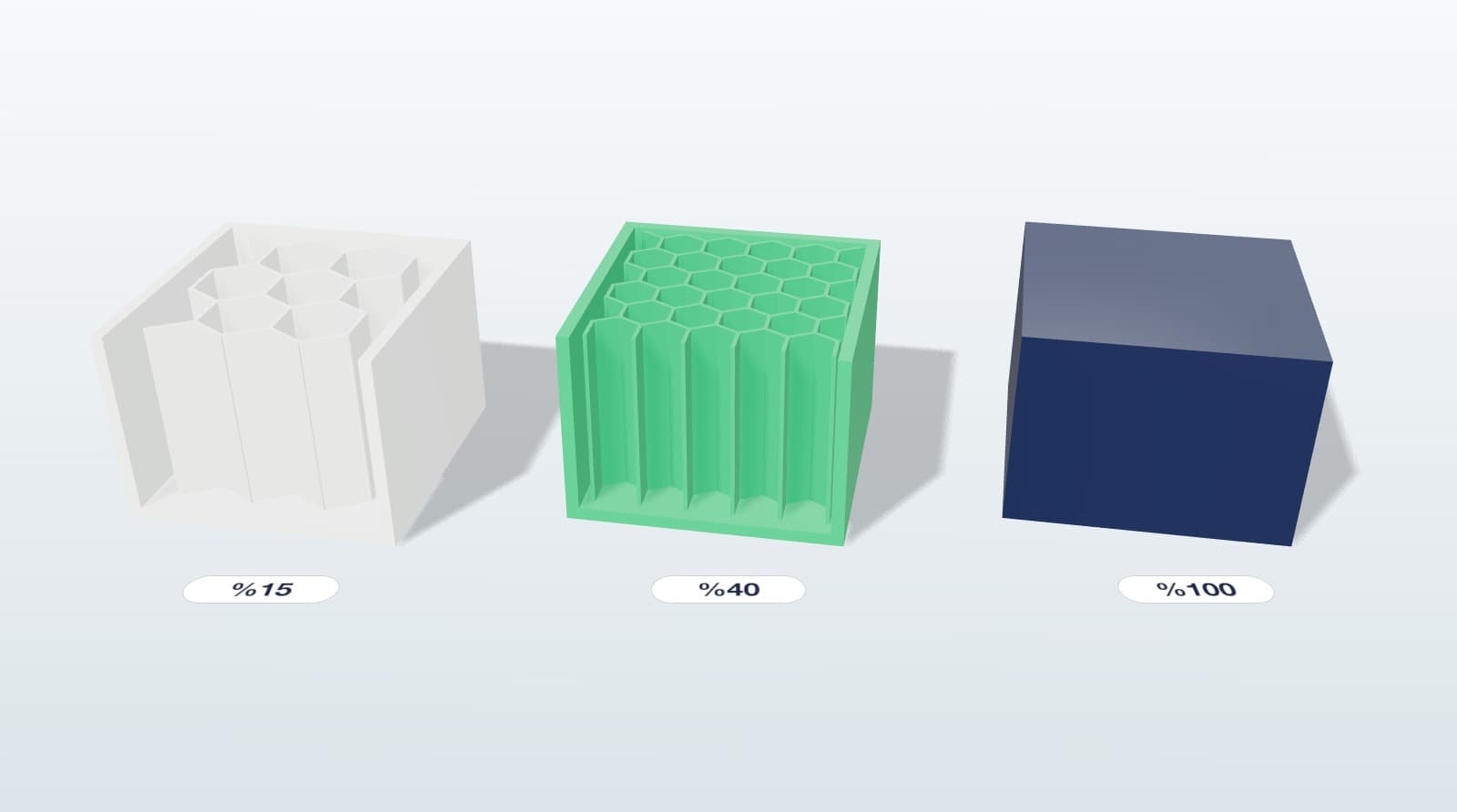
FDM parts are not printed solid; inside the outer walls there is an infill pattern such as honeycomb or gyroid. For visual prototypes, 10 – 20% infill is often enough; load-bearing parts call for 40 – 60% infill and extra walls. Because the outer walls carry most of the strength, adding walls is usually more economical than increasing infill.
4. Supports and print orientation
Overhangs and bridges need supports. Supports use material and time, and removing them and cleaning the surface means labor. How the part is placed on the bed affects supports, surface quality and strength together. That is why orienting the part optimally is one of the engineering decisions that affects the price the most.
5. Choice of technology
The same part costs differently with FDM and SLA. For large, functional parts FDM is usually more economical; for small parts that need very fine detail and smooth surfaces SLA stands out. The technology should be chosen for the function expected from the part; choosing a more precise method than necessary raises the price for no reason.
6. Post-processing
Support cleanup, sanding, primer and paint, heat-set insert installation and surface smoothing require manual work and add to the price. For colored parts, choosing multicolor printing instead of paint removes both the painting labor and the risk of paint wearing off over time.
7. Quantity
Every print job has a fixed setup cost: file check, slicing, machine preparation and quality control. As quantity grows, this cost is spread across the parts; and since the bed can be filled with multiple parts at once, the unit price drops. Because it needs no molds, 3D printing is often the most economical route for small series from a single part to a few hundred.
8. Tolerances and quality expectations
Typical FDM tolerances are enough for standard parts. But if there are dimensions for fits, bearings or assembly, they need to be checked specifically and a test print may be needed. Stating critical dimensions at the quotation stage gives you both the right price and the right part the first time.
How to lower the price
- Increase layer height for functional parts; go thinner only when surface quality really matters.
- Do not ask for more infill than needed; consider adding walls for strength.
- Steepen overhangs flatter than 45° from horizontal with chamfers or fillets to reduce the need for supports.
- Design large, simple parts as one piece instead of assemblies; group small parts on the same bed.
- Choose the material for the conditions the part will really face: ASA for outdoors, PA-CF for high strength.
- Plan your quantity in advance: batch production lowers the unit price compared to one-off orders.
What should you send for an accurate quote?
- 3D model file: STEP if possible, otherwise STL or 3MF
- Quantity and any expected repeat orders
- Where the part will be used: temperature, sunlight, chemicals, loads
- Color and surface expectations
- Critical dimensions and tolerances
- Desired delivery date
You can upload your file through the quote form. Our engineers review your part and choose with you the most economical and reliable option for material, orientation and infill.
Let's choose the best method for your project together.
Get a quote