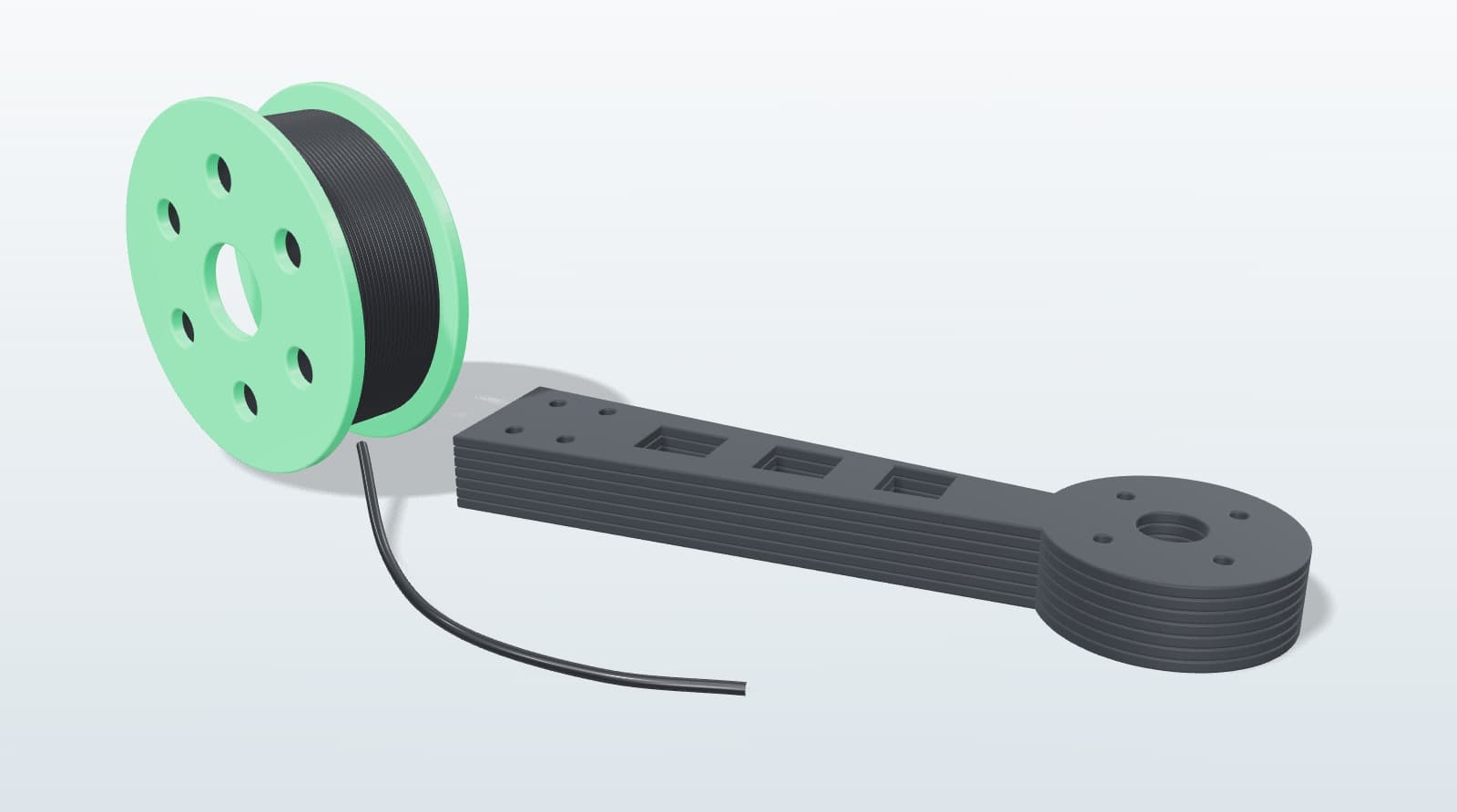
What is carbon fiber filament?
Carbon fiber filament is made by adding short chopped carbon fibers to a thermoplastic (such as nylon, PET or PPS). The fibers align in the extrusion direction during printing and give the part a stiffness the plastic alone could not. The result is lightweight, bend-resistant, dimensionally stable parts with a matte surface.
An important distinction: these materials are not continuous carbon fiber composites (such as prepreg carbon plates). Because the fibers are short, the gain in strength is limited; the main benefit is stiffness and dimensional stability.
Why choose it?
- Stiffness: flexes much less than unreinforced plastic of the same thickness.
- Dimensional stability: shrinks less while cooling and warps less; large, flat parts come out straighter.
- Light weight: a much lighter part can often replace a metal bracket.
- Heat resistance: nylon, PPA and PPS based grades in particular keep their shape at high temperatures.
- Surface: a matte, uniform surface hides layer lines; the part looks ready for the end user.
Which carbon fiber filament for which job?
- PA6-CF / PA-CF: high strength and heat resistance. The most popular industrial choice for fixtures, tooling, robot and drone parts, and brackets near the engine bay.
- PA12-CF: thanks to its nylon 12 base it is less affected by moisture and more dimensionally stable. Suitable for precise snap fits and humid environments.
- PET-CF: does not absorb moisture, is easy to process and resists chemicals well. An economical alternative for enclosures and brackets that need dimensional stability.
- PPA-CF and PPS-CF: for harsh environments that need high temperature and chemical resistance; they stand out in parts in contact with fuel, oil and hot air.
- PLA-CF and PETG-CF: an economical entry option for rigid visual prototypes, models and low-temperature functional parts.
Know the limits too
While carbon fiber stiffens the part, it lowers impact strength and elongation at break; for parts that take sudden impacts and must flex, unreinforced nylon or TPU may be better. In FDM parts, the bond between layers is weaker than the strength within a layer, so the load direction must be considered together with the print orientation. Nylon-based grades absorb moisture from the air; the filament must be dried before printing for the right result. Carbon fiber is abrasive and needs a hardened nozzle. Carbon-filled parts are also not fully electrically insulating; glass fiber reinforced (GF) grades should be chosen where insulation is required.
Carbon fiber or glass fiber?
Glass fiber (GF) reinforced filaments are not as stiff as carbon fiber, but they are tougher, tolerate impacts better and are usually more economical. Glass fiber also stands out for parts that need electrical insulation. If stiffness and light weight are the top priority, carbon is a good starting point; if toughness and cost come first, glass fiber is.
Design tips
- Orient the part so the main load runs parallel to the layer lines.
- Add fillets to sharp internal corners to reduce stress concentration.
- Add walls rather than infill for strength.
- Use heat-set inserts (brass bushings) for screw connections that are assembled and disassembled often.
- State fit and bearing dimensions at the quotation stage; a test print can be made if needed.
How we produce in our workshop
At TAİ Robotik we produce with carbon and glass fiber reinforced PLA, PETG, ABS, ASA, PET, PC, PA, PPA and PPS filaments. We dry nylon-based filaments before printing and print them on enclosed machines with hardened nozzles. Describing the conditions your part will work in is enough for us to choose the right material together.
Let's choose the best method for your project together.
Get a quote